


World Cup Stadiums 2026: Every Venue Hosting FIFA’s Biggest Tournament
There’s something about World Cup stadiums that gets stuck in your memory before the goals do. Maradona at Azteca. Zidane at the Olympiastadion. Iniesta in Johannesburg. You remember where it happened first, then who scored. The stadium holds the noise, the heat, the total chaos of it. And in 2026, there are 16 of them spread across three countries for the biggest World Cup anyone’s ever tried to pull off.
Forty-eight teams. Three host nations. A tournament map running from Vancouver all the way down to Guadalajara. If you’re planning to travel, saving up to try, or just curious which venues are actually worth getting excited about – this is the full rundown.
How Many Stadiums Will Host the 2026 World Cup?
Sixteen venues across three countries. The US carries the most weight with 11 stadiums. Mexico has three. Canada gets two.
This is the first World Cup with 48 teams instead of 32 – a big enough jump that it basically broke the old single-host format. So FIFA spread it across the United States, Mexico, and Canada. That adds up to 104 matches total, which is close to double what we saw in Qatar. More group stage drama, more travel between cities, more weird late-night kickoffs depending on where you’re watching from.
It’s a lot. Maybe too much, honestly. Scale this big starts to feel unwieldy after a while, and I’m genuinely not sure FIFA has totally thought through what 48 teams does to the group stage tension. But we’ll find out.
Full World Cup Stadium List
| Stadium | City | Country | Capacity | Notes |
|---|---|---|---|---|
| Estadio Azteca | Mexico City | Mexico | ~83,000 | Hosts the opening match. Third World Cup appearance. |
| Estadio BBVA | Monterrey | Mexico | ~53,500 | Modern, mountain backdrop, home of Rayados. |
| Estadio Akron | Guadalajara | Mexico | ~48,000 | Home of Chivas. Iconic volcano-shaped roof. |
| MetLife Stadium | East Rutherford (New York/New Jersey) | USA | ~82,500 | Hosts the Final. |
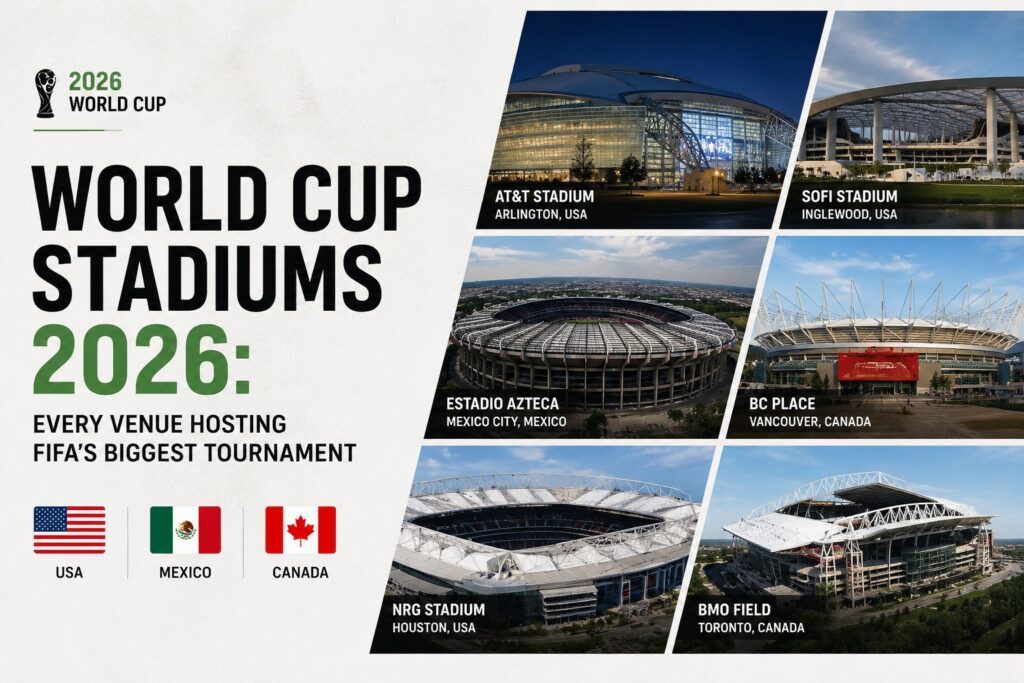
| SoFi Stadium | Inglewood (Los Angeles) | USA | ~70,000 | Cutting-edge venue, Rams and Chargers home. |
| AT&T Stadium | Arlington (Dallas) | USA | ~80,000 | Will host several knockout matches. |
| Mercedes-Benz Stadium | Atlanta | USA | ~71,000 | Retractable roof, MLS-tested atmosphere. |
| NRG Stadium | Houston | USA | ~72,000 | Indoor option, useful for Texas heat. |
| Levi’s Stadium | Santa Clara (San Francisco Bay Area) | USA | ~68,500 | Tech-heavy, 49ers home. |
| Lincoln Financial Field | Philadelphia | USA | ~69,000 | One of the loudest NFL stadiums. |
| Arrowhead Stadium | Kansas City | USA | ~76,000 | Famously deafening crowd. |
| Gillette Stadium | Foxborough (Boston) | USA | ~65,000 | Patriots’ home, undergoing pitch changes. |
| Hard Rock Stadium | Miami Gardens | USA | ~65,000 | Will likely host the third-place match. |
| Lumen Field | Seattle | USA | ~69,000 | Soccer-mad city, electric atmosphere. |
| BC Place | Vancouver | Canada | ~54,500 | Retractable roof, downtown setting. |
| BMO Field | Toronto | Canada | ~45,000 (expanded) | Toronto FC’s home, being expanded for 2026. |
Mexico’s World Cup Stadiums
Mexico isn’t just hosting. It’s making history. With 2026, it becomes the first country to host or co-host three World Cups – 1970, 1986, and now this one. Three stadiums carry that legacy, and each one’s got its own character.
Estadio Azteca – Mexico City
Where do you even start with Azteca? It’s the cathedral. The pitch where Pelé lifted the trophy in 1970 and where Maradona did, well, both of those things in 1986 (you know exactly which two). Come 2026, it’ll be the first stadium to host matches at three separate World Cups. No other venue on this planet has that.
Sitting at roughly 2,200 meters above sea level, the altitude absolutely punishes visiting teams who haven’t spent real time acclimatizing up there. Your lungs just don’t cooperate the same way. After recent renovations, capacity is around 83,000, and when El Tri plays, the place becomes something you genuinely have to be inside to understand. That’s also where the tournament kicks off. Fitting, really, that the most storied stadium on the list gets to open the whole thing.
Estadio BBVA – Monterrey
If Azteca is the soul of Mexican football, BBVA is the sleek newer sibling. Opened in 2015, home to Rayados, and genuinely one of the prettier stadiums in Latin America. The Cerro de la Silla mountain sits behind one of the stands, and at sunset the view is almost unfairly good. Around 53,500 capacity, modern construction, excellent sightlines. Northern Mexico also tends to bring cooler nights than central Mexico, so the playing conditions tend to be a bit kinder for football.
Estadio Akron – Guadalajara
Home of Chivas, and probably the most visually striking stadium in the country. That grass-covered exterior shaped like a volcano – you don’t forget it after you’ve seen it. Sits at around 48,000 capacity. Guadalajara as a city is genuinely football-mad, the food scene is excellent, and tequila country is basically on the doorstep. If you’re traveling for the group stage and trying to pick one Mexican city to base yourself in, Guadalajara makes a strong case.
USA Host Stadiums
The US is hosting more matches than any single country in World Cup history. Eleven stadiums, coast to coast, all of them NFL buildings adapted for football. So here’s a straight take on what you’re actually getting with each one.
MetLife Stadium (New York/New Jersey) – This is where the Final lands. Around 82,500 capacity, sitting in East Rutherford, New Jersey – technically not New York City, but nobody’s going to care about that when the trophy’s being lifted. The Giants and Jets play here, and FIFA picked it for the size, the global attention New York brings, and its track record handling massive events. July 19, 2026 is the date. Mark it.
SoFi Stadium (Los Angeles) – Opened in 2020, futuristic design, that enormous overhead video screen. Rams and Chargers home. Hollywood will absolutely show up for this one.
AT&T Stadium (Dallas) – Jerry World. Air-conditioned, enormous, almost aggressively large in scale. Texas in summer is genuinely brutal, so the indoor cooling isn’t just a nice touch – it’s necessary.
Mercedes-Benz Stadium (Atlanta) – Sharp design, retractable roof, and Atlanta United has already proven the city shows up for football. One of the better-built venues on the whole list, if you ask me.
NRG Stadium (Houston) – Fully enclosed when needed. Another Texas venue where playing in open air during July would be a real problem.
Levi’s Stadium (Bay Area) – Just outside San Francisco, 49ers territory. Northern California summers are much gentler than Texas or Florida, which is genuinely a selling point for this venue.
Lincoln Financial Field (Philadelphia) – Eagles fans are famously loud. World Cup crowds will probably be louder. Philly’s also a walkable city with character, which helps for fans spending multiple days there.
Arrowhead Stadium (Kansas City) – Guinness record holder for loudest NFL stadium. Think about what that sounds like for a quarterfinal. I’d genuinely love to see which match ends up here because that crowd is going to be something else entirely.
Gillette Stadium (Boston area) – Foxborough is a 45-minute drive from Boston, which matters if you’re trying to do the city properly. New England football culture is stronger than people outside the US usually realize.
Hard Rock Stadium (Miami) – Likely host of the third-place playoff. June in Miami is genuinely humid and hot, no getting around that, but the Latin American energy in that city during a World Cup will be unlike anything else in the US. You won’t feel like you’re that far from the tournament’s heartland.
Lumen Field (Seattle) – Sounders fans have built a real football culture here, probably the strongest in the US. People write Seattle off as rainy, but the summers there are actually dry and genuinely pleasant – one of those things locals know and visitors are always surprised by. Good city to be in for a week.
Canada’s World Cup Stadiums
Two stadiums, and Canada’s hosting men’s World Cup football for the first time. That’s genuinely a big deal for the country.
BC Place – Vancouver
Right in downtown Vancouver, retractable roof, around 54,500 capacity. Pacific Northwest weather can turn on you fast, so that roof matters more than it might seem. The setting is hard to beat – mountains, ocean, a city center you can actually walk around in. For traveling fans, Vancouver might be the single most pleasant host city on the entire 2026 map.
BMO Field – Toronto
Toronto FC’s home ground, currently being expanded to push past 45,000 for 2026. It’s smaller than most other venues in the tournament – by a fair margin. But it’s a proper football stadium, built for the sport, not converted from NFL use, and that usually shows in how the atmosphere carries. Toronto is also one of the most genuinely diverse cities anywhere, which means practically every team playing there will find a crowd of local supporters in the stands.
Most Iconic World Cup Venue in 2026
It’s Azteca. Was always going to be Azteca.
No stadium anywhere has hosted two World Cup finals. None will have appeared in three separate tournaments before Azteca does this one. The weight of history in that concrete bowl is heavier than anything else on this list – Pelé, Maradona, the Hand of God, the Goal of the Century, the 1986 Final against West Germany, the altitude, the smoke rising from the stands, that wall of noise when Mexico plays at home.
You could make the argument that MetLife matters more because it holds the Final. Fine. But importance and being iconic aren’t really the same thing. MetLife is a venue. Azteca is a place. Anyone who’s been to both knows that gap immediately.
When Mexico kicks off the whole tournament there, it’ll be one of those football moments people are still talking about years later.
Best Stadiums for Fans Traveling to the Tournament
Picking the right city matters more than picking the right stadium, if we’re being practical. You’ll spend way more time in the streets than inside the ground. Here’s a realistic take on where to go.
For Mexican fans staying domestic: Guadalajara is probably the sweet spot. Good prices, strong football culture, great food, and Estadio Akron is genuinely fun to watch a match in. Monterrey works well too if you prefer something more modern and you can handle the heat.
For Latin American flavor in the US: Miami and Los Angeles, easily. Both cities will feel like extensions of South America for the duration of the tournament. Hard Rock and SoFi will draw fans up from Mexico, Colombia, Argentina, everywhere.
For pure atmosphere: Seattle and Kansas City. Both of those crowds will rattle the stands for any big match.
For combining football with actually exploring somewhere: Vancouver and Boston. Both are places you’d genuinely want a week in regardless of the tournament.
For the full spectacle: Mexico City, no debate. The altitude and the traffic are real inconveniences, but sitting inside Azteca for a World Cup match is the kind of thing you’ll bring up in conversation for the rest of your life.
One practical note: book accommodation now. Seriously, earlier than feels reasonable. Host cities with multiple matches are already seeing prices climb, and anything close to a venue on match days goes fast.
Which Stadium Hosts the Final?
MetLife Stadium gets the Final – July 19, 2026, East Rutherford, New Jersey. Capacity around 82,500. The Giants and Jets both call it home, and FIFA’s reasoning for picking it comes down to three things: sheer size, the global media pull of the New York market, and a proven track record with massive international events.
Azteca gets the opening match. Hard Rock Stadium in Miami is expected to take the third-place playoff. The bigger knockout games get distributed among the larger venues – AT&T, SoFi, MetLife, Mercedes-Benz Stadium will probably absorb most of the late-round drama.
There’s a symbolism in the structure that’s hard to ignore, especially for Mexico. The tournament starts at Azteca, the most historically loaded football stadium on the continent, and wraps up just outside New York. Two ends of North America. One trophy somewhere in the middle.
Sixteen stadiums, three countries, and a summer that’s shaping up to be louder and stranger than any World Cup before it. Pick your venue carefully. These are the buildings that’ll hold whatever memories everyone’s still arguing about in 2045.