

Bota de Oro del Mundial: Historia, Ganadores y Cómo Funciona
 Visual creado con IA
 Cada cuatro años, el Mundial nos regala un espectáculo paralelo casi tan emocionante como el trofeo mismo. La carrera por los goles. La búsqueda de la Bota de Oro. Verás a los delanteros revisando las tablas de goleo entre partidos, a los entrenadores decidiendo si poner a una estrella un medio tiempo más, a los aficionados haciendo cuentas mentales después de cada gol. Es el duelo más personal del futbol dentro de un deporte de equipo.
¿Y la verdad? Algunos de los momentos más inolvidables del Mundial vinieron de jugadores que iban tras ese premio, no tras el trofeo.
¿Qué Es la Bota de Oro del Mundial?
Idea simple, prestigio enorme. Un número, un jugador, un premio: el máximo goleador del torneo se lo lleva a casa. Básicamente eso es.
Sin embargo, el nombre tardó en pegar. Durante décadas fue simplemente el honor al “máximo goleador”, sin ninguna marca elegante. La FIFA lo hizo oficial como el “Zapato de Oro” en 1982, luego Adidas se sumó y lo rebautizó como la Bota de Oro en 2010. Ahora también hay tres niveles: oro, plata y bronce para los tres máximos goleadores en general.
Ganar un Mundial requiere de toda una plantilla, un cuerpo técnico, un poco de suerte. La Bota de Oro es solo tuya. Eso es raro a nivel de selección nacional. Pelé nunca ganó una. Maradona nunca ganó una. Ese solo hecho te dice todo sobre lo difícil que realmente es conseguirla.
Cómo Se Decide la Bota de Oro
La primera regla es la obvia. Quien anote más goles en el torneo la gana. ¿Pero qué pasa cuando dos o tres jugadores empatan? Ahí es donde se pone interesante.
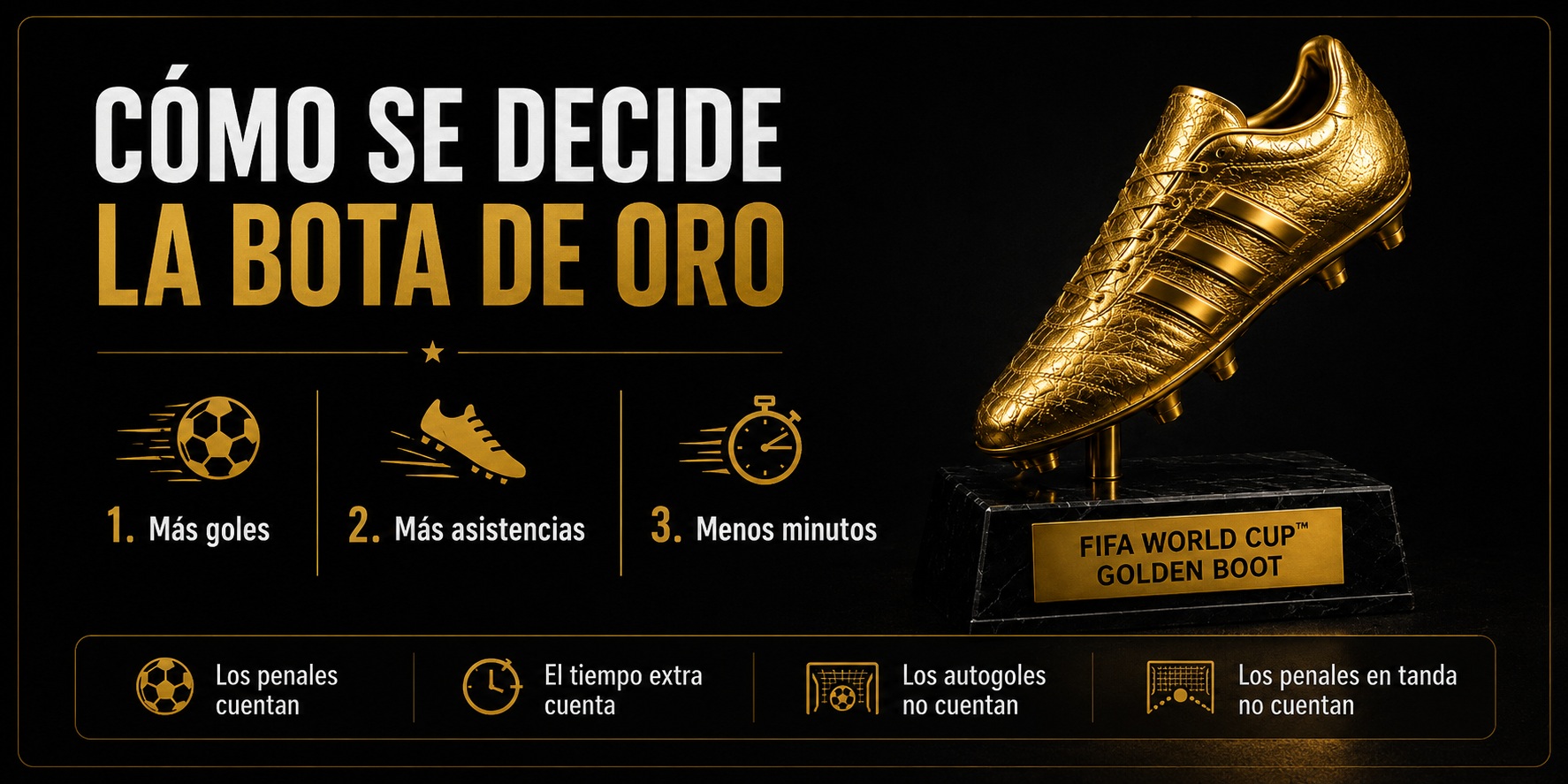
La FIFA usa una serie clara de criterios de desempate, en este orden:
1. Más goles anotados. Si alguien termina solo en la cima, listo. Premio entregado, sin debate.
2. Más asistencias. Si dos jugadores empatan en goles, gana el que tenga más asistencias. Esta regla decidió de manera famosa la Bota de Oro de 2018. Harry Kane anotó 6 goles para Inglaterra. Antoine Griezmann y Romelu Lukaku también terminaron cerca, pero Kane fue claro en goles. La regla de asistencias importó más en 2010, cuando Thomas Müller, David Villa, Wesley Sneijder y Diego Forlán terminaron todos con 5 goles. Müller la ganó por las asistencias.
3. Menos minutos jugados. Si goles y asistencias siguen empatados, el jugador que anotó esos goles en menos tiempo se lleva el visto bueno. ¿La lógica? La eficiencia. Hiciste más con menos.
Los penales cuentan. Los goles en tiempo extra cuentan. Los autogoles nunca cuentan para el goleador (obviamente). ¿Los goles en tandas de penales? No, esos tampoco cuentan: un pequeño detalle que muchos aficionados malentienden.
 Visual creado con IA
Todos los Ganadores de la Bota de Oro del Mundial
| Año | Jugador | País | Goles |
|---|---|---|---|
| 1930 | Guillermo Stábile | Argentina | 8 |
| 1934 | Oldřich Nejedlý | Checoslovaquia | 5 |
| 1938 | Leônidas | Brasil | 7 |
| 1950 | Ademir | Brasil | 8 (oficialmente 9 en algunas fuentes) |
| 1954 | Sándor Kocsis | Hungría | 11 |
| 1958 | Just Fontaine | Francia | 13 |
| 1962 | Varios (seis jugadores empatados) | – | 4 |
| 1966 | Eusébio | Portugal | 9 |
| 1970 | Gerd Müller | Alemania Occidental | 10 |
| 1974 | Grzegorz Lato | Polonia | 7 |
| 1978 | Mario Kempes | Argentina | 6 |
| 1982 | Paolo Rossi | Italia | 6 |
| 1986 | Gary Lineker | Inglaterra | 6 |
| 1990 | Salvatore Schillaci | Italia | 6 |
| 1994 | Hristo Stoichkov / Oleg Salenko | Bulgaria / Rusia | 6 |
| 1998 | Davor Šuker | Croacia | 6 |
| 2002 | Ronaldo | Brasil | 8 |
| 2006 | Miroslav Klose | Alemania | 5 |
| 2010 | Thomas Müller | Alemania | 5 |
| 2014 | James Rodríguez | Colombia | 6 |
| 2018 | Harry Kane | Inglaterra | 6 |
| 2022 | Kylian Mbappé | Francia | 8 |
Las Campañas Más Famosas por la Bota de Oro
 Visual creado con IA
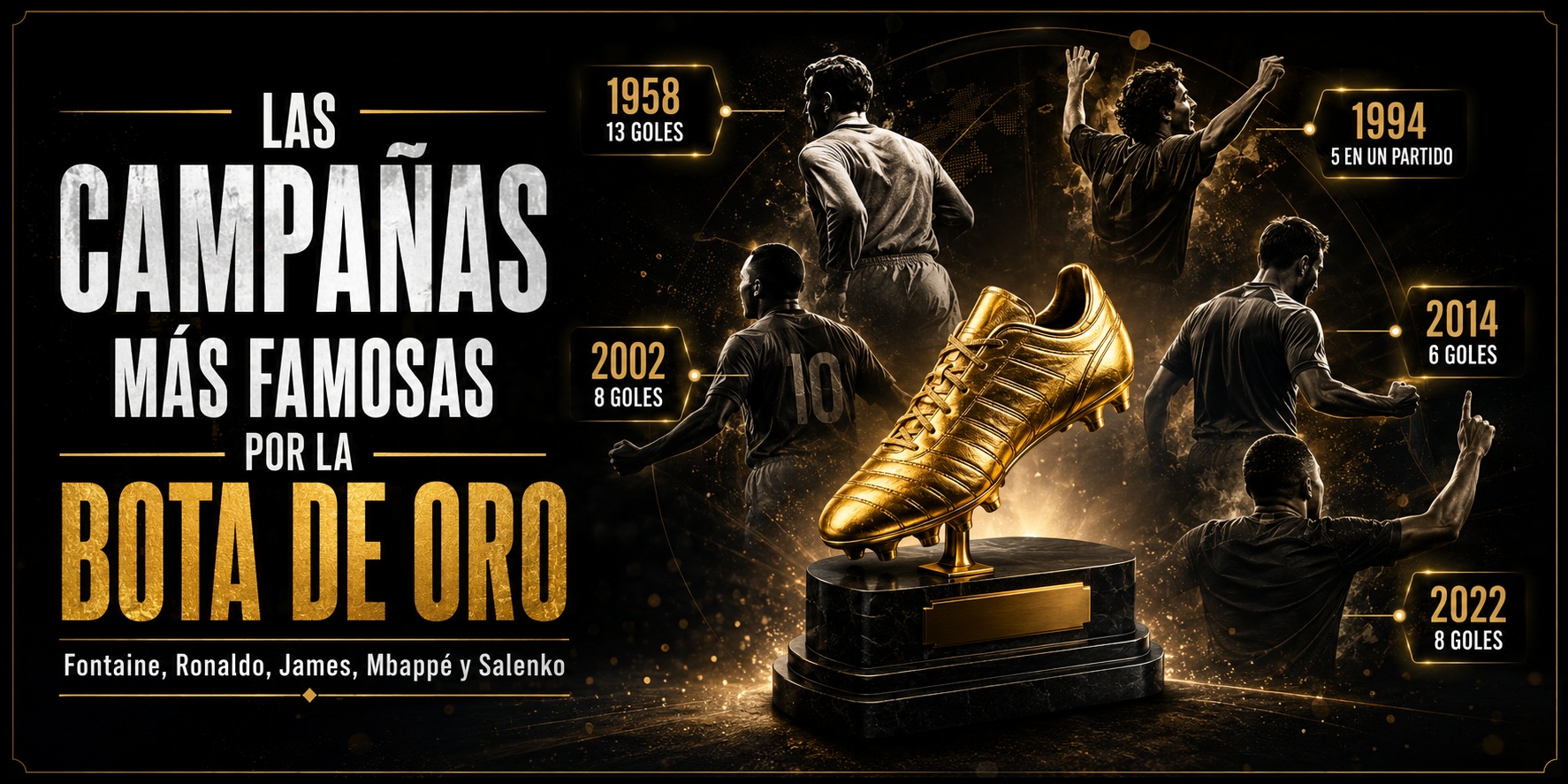
Just Fontaine, 1958. Trece goles en seis partidos. Léelo otra vez. Trece. Francia no ganó el torneo, lo ganó Brasil, pero Fontaine dejó Suecia con un récord que nadie ha tocado en casi siete décadas. Y la historia detrás es casi demasiado buena: solo entró al equipo titular porque un compañero se lesionó. Eso es todo. Una mala racha para otro, y Fontaine entró directo a la historia. El récord se siente casi mitológico a estas alturas.
Ronaldo, 2002. Este es emocional. Cuatro años antes, el fenómeno brasileño tuvo un colapso misterioso antes de la final de 1998 y todo el país se dolió. En 2002 regresó de lesiones serias de rodilla que casi terminan con su carrera, anotó 8 goles, incluyendo los dos en la final contra Alemania, y levantó el trofeo. Historia de redención, completa.
James Rodríguez, 2014. Llegó al torneo como un chico talentoso que la mayoría de los aficionados casuales no había estudiado realmente. Se fue como una estrella global. Seis goles, incluyendo ese absurdo bombazo de pecho y volea contra Uruguay que ganó el gol del torneo. El Real Madrid lo fichó casi de inmediato después. La Bota de Oro puede cambiar una carrera en tres semanas.
Mbappé, 2022. Perdió la final pero ganó la bota. Ocho goles, incluyendo un hat-trick en la final misma, lo cual todavía cuesta procesar. Argentina ganó el trofeo con Messi, claro, pero la actuación individual de Mbappé en Qatar fue algo que el futbol no olvidará pronto.
Salenko, 1994. El raro. Oleg Salenko anotó 5 goles en un solo partido contra Camerún. Rusia quedó eliminada en la fase de grupos. Nunca volvió a anotar otro gol internacional en su carrera. Y compartió la Bota de Oro. El futbol es extraño a veces.
Récords de Goleo del Mundial
Los 13 goles de Fontaine en un solo torneo son el récord del que ya nadie habla de romper, porque simplemente se siente intocable. El formato moderno te da un máximo de 7 partidos si llegas a la final. Para superar 13, un delantero tendría que anotar dos veces en cada partido. No va a pasar.
En cuanto a goles de Mundial de todos los tiempos a lo largo de varios torneos, Miroslav Klose está en la cima con 16, repartidos en cuatro torneos entre 2002 y 2014. Ronaldo tuvo 15. Gerd Müller 14. Luego vienen Just Fontaine y Pelé empatados en 13, lo cual es increíble considerando que Fontaine llegó ahí en un solo torneo y Pelé jugó cuatro.
Mbappé ya tiene 12 goles de Mundial a los 25 años. Tiene tiempo. Tiempo real.
Un par de otros récords que vale la pena tener en mente: Geoff Hurst sigue siendo el único jugador en la historia que anotó un hat-trick en una final de Mundial: 1966, Inglaterra, ya saben cuál. Mbappé igualó la hazaña del hat-trick en 2022 pero perdió el partido. Y Pelé sigue siendo el goleador más joven en una final de Mundial, a los 17 años en 1958.
Las Carreras por la Bota de Oro Más Cerradas de la Historia
2010 en Sudáfrica es el estándar de oro para una carrera apretada. Cuatro jugadores terminaron con 5 goles cada uno: Müller, Villa, Sneijder, Forlán. Los criterios de desempate tuvieron que trabajar tiempo extra. Müller la ganó por asistencias, pero Forlán se llevó el Balón de Oro como mejor jugador. Cuatro tipos, el mismo número de goles, un premio. Genuinamente difícil encontrar una más cerrada en cualquier otro torneo.
1994 fue diferente. Stoichkov y Salenko anotaron 6 cada uno. Una fue una actuación a lo largo de todo el torneo de un equipo de Bulgaria que sorprendió a todos al llegar a las semifinales. La otra fue una tarde histórica de un delantero ruso cuyo equipo se fue a casa en la fase de grupos. Dos historias completamente diferentes, el mismo premio.
2018 también tuvo su momento. Kane anotó la mayoría de sus goles temprano, incluyendo penales y un desvío contra Panamá, y la gente empezó a discutir si la Bota “debería” ir a un jugador cuyos goles llegaron en partidos más duros. A las reglas no les importa eso. Un gol es un gol.
¿Podría Alguien Romper los Grandes Récords?
¿Los 13 de Fontaine? Probablemente no. El juego moderno es más táctico, las defensas están organizadas de maneras que 1958 no podía imaginar, y los delanteros de élite normalmente reparten goles con sus compañeros. Además, los mejores equipos enfrentan rivales más duros antes ahora.
¿Los 16 de todos los tiempos de Klose? Tal vez. Mbappé es el candidato obvio. Si juega en 2026 y 2030, solo necesita seguir anotando aproximadamente al mismo ritmo. Erling Haaland también podría perseguirlo, asumiendo que Noruega realmente califique a los torneos de manera consistente, que es la parte que nadie puede garantizar.
El nuevo formato de 48 equipos que comienza en 2026 cambia las cuentas. Más partidos para los finalistas significan más oportunidades de anotar. Eso por fin podría empujar a alguien más allá del techo moderno de 8 goles en un solo torneo.
¿Quién Podría Ganar la Próxima Bota de Oro?
El Mundial de 2026 está repartido entre México, Estados Unidos y Canadá. Con el formato expandido, los finalistas podrían jugar hasta 8 partidos en lugar de 7. Ese partido extra importa más de lo que la gente cree cuando estás contando goles, y la vara de la Bota de Oro podría terminar más alta que nunca.
Mbappé es el favorito obvio, asumiendo que Francia llegue lejos de nuevo. Está en su mejor momento, ya demostró que sube su nivel en este escenario, y Francia probablemente estará entre las favoritas al título.
Haaland es el otro nombre. Si Noruega califica, su puro instinto goleador es el mejor del mundo ahora mismo. Si Noruega le da suficientes partidos para ganarla es la verdadera pregunta.
Luego tienes a los tapados. Vinícius Júnior por Brasil. Lautaro Martínez por Argentina si Messi da un paso atrás. Harry Kane podría repetir. Y Julián Álvarez: la verdad, la gente lo subestima más de lo que debería. Es el tipo de delantero que simplemente acumula goles en silencio sin llamar mucho la atención, y luego revisas las estadísticas y dices “ah, claro.” Además siempre hay alguien de quien nadie está hablando todavía. Una situación tipo James Rodríguez 2014. Un momento tipo Salvatore Schillaci 1990. El torneo siempre produce uno.
Para los aficionados mexicanos, el sueño de la Bota de Oro es más lejano. Ningún mexicano la ha ganado jamás. Hugo Sánchez tuvo la carrera de clubes para justificar el sueño, pero el escenario del Mundial nunca le dio del todo la plataforma que su talento merecía. ¿Podría Santiago Giménez cambiar eso en suelo propio? Es difícil, pero el suelo propio hace cosas extrañas con los delanteros.
Esa es la belleza de la Bota de Oro. Puedes predecir a los candidatos, estudiar la forma, mapear los partidos. Pero en cada Mundial, la bota encuentra su propia historia. A veces es la superestrella que todos esperaban. A veces es un jugador del que nadie había oído hablar tres semanas antes. Y al final, su nombre queda en los libros de récords para siempre, junto a Fontaine, Müller, Ronaldo y Mbappé. No es mala compañía.