
Football betting odds look intimidating at first. You open a sportsbook, see a wall of numbers next to Real Madrid vs Barcelona, and suddenly nothing makes sense. 2.10? -150? 7/2? Honestly, it’s a lot to take in all at once.
Good news though. Odds are basically two things wrapped into one: a probability and a payout. That’s it. Once those two pieces click, reading a betting market gets way less confusing. Everything else is just detail on top of that foundation.
This guide walks you through how football betting odds work in plain English, with real football examples you can actually picture. By the end, you’ll know how payouts get calculated, why odds shift before kickoff, what implied probability means, and how bookmakers price every match. No fluff, no pressure to bet – just the stuff a new user in Mexico needs to read odds with confidence.
What Are Football Betting Odds?
Odds are the price of a bet. Think of them like a price tag on something at the store. Two things get baked into that number at once: what chance the bookmaker thinks an outcome has, and how much you’d get back if you’re right.
Say Club América is a heavy favorite at home against a smaller side. Their odds will be low – maybe something like 1.40. Why? Because the bookmaker thinks they’ll probably win. Low odds, small payout. Flip it around and you’ve got the underdog: higher odds, bigger potential return if they actually pull it off.
Bookmakers (or casas de apuestas, if you’re used to the Spanish term) don’t pick odds out of thin air. They look at form, injuries, home advantage, head-to-head history, market activity, and a bunch of other things. Then they price each outcome and quietly add a small margin for themselves. More on that margin in a bit.
The Main Types of Betting Odds
There are three formats you’ll run into. Most sportsbooks in Mexico default to decimal, which is honestly the easiest one to start with. But you should at least recognize the others so nothing catches you off guard.
Decimal Odds
This is the format I’d recommend any beginner stick with. It’s clean and the math is almost embarrassingly simple.
The formula: stake × decimal odds = total payout.
That total includes your original stake. Bet $10 at odds of 2.00 and you walk away with $20. Your profit is $10. Bet $10 at 3.50? You get $35 back, $25 of which is actual profit.
Quick example on a Manchester City vs Liverpool match:
- Man City to win: 2.10
- Draw: 3.40
- Liverpool to win: 3.60
Put $50 on Liverpool at 3.60 and they win, you collect $180. Simple as that.
American Odds
You’ll see these on some platforms, especially ones with US influence. They use a plus or minus sign.
A minus number like -200 shows the favorite. It shows how much you’d need to risk to earn $100 back in profit. So -200 means you put in $200 to win $100.
A plus number like +150 shows the underdog. That’s how much profit you’d collect on a $100 bet. +150 means a $100 bet returns $150 in profit, plus your stake back.
Mexico vs USA in a friendly? You might see Mexico at -120 and USA at +180. Mexico is the favorite, USA is the underdog. Same idea as decimal odds, just a different way of showing it.
Fractional Odds
Mostly a British thing. Written like 5/2 or 7/4. First number is profit, second is stake. So 5/2 means you win $5 for every $2 you bet. You probably won’t see much of this in Mexico, but now you won’t be confused when you do.
How Football Betting Payouts Work
Let’s run through actual payouts so this stays concrete.
Example 1: $10 on Chivas at 2.00. You win, you get $20 back. Profit: $10.
Example 2: $20 on Barcelona at 1.75. You win, you get $35 back. Profit: $15.
Example 3: $50 on an underdog at 4.50. They somehow pull it off, you collect $225. Profit: $175.
The formula never changes. Stake times decimal odds equals total return. Subtract your stake and you’ve got your profit. After a few rounds of doing this manually, it becomes second nature – you won’t need a calculator.
One thing beginners mess up constantly: your payout includes your original stake. Profit is the bit on top of that. They’re not the same number. Keep them straight.
What Is Implied Probability?
Okay, this is where it gets genuinely useful – and where most casual bettors check out too early.
Every set of odds has a hidden probability inside it. The formula is: 1 ÷ decimal odds × 100.
So:
- Odds of 2.00 = 50% implied probability
- Odds of 1.50 = roughly 66.7%
- Odds of 3.00 = about 33.3%
- Odds of 5.00 = 20%
What this tells you is what chance the bookmaker is pricing into an outcome. Real Madrid at 1.50 against a weaker side? The market’s saying they’ve got roughly a two-in-three shot at winning.
Why does this matter? Because it helps you figure out whether a bet is actually worth taking. If you genuinely believe a team has a much better chance than the odds suggest, that’s where value might exist. If the odds look accurate or worse – probably best to skip it.
You don’t need to run this calculation on every single bet. But knowing the concept changes how you read numbers. It stops being a random figure and starts being an actual statement about probability.
Common Football Betting Markets and Their Odds
Football has dozens of markets. Here are the main ones you’ll come across regularly.
Match Winner (1X2)
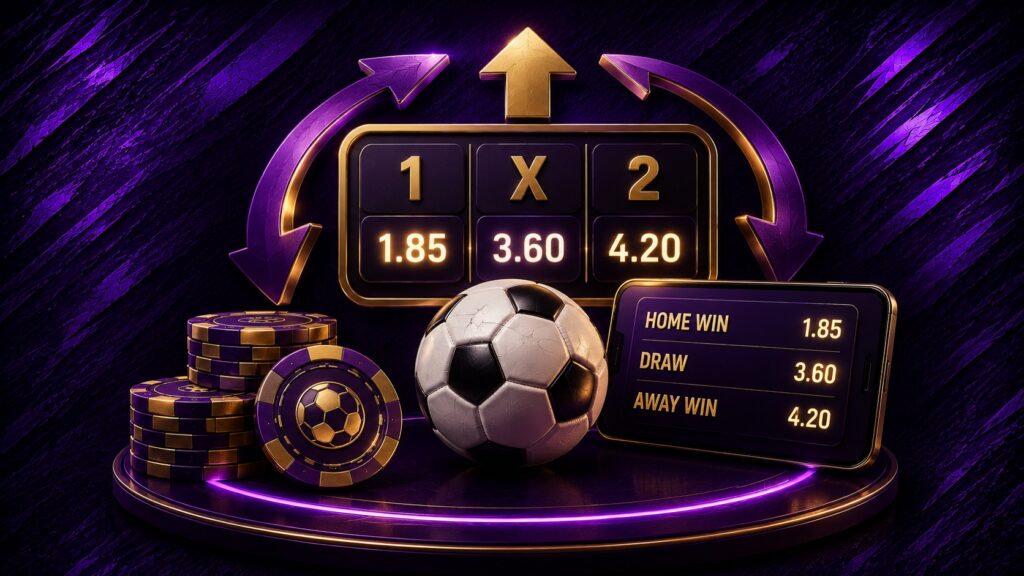
The classic. Three outcomes: home win (1), draw (X), or away win (2). Real Madrid vs Barcelona might look like 2.20 / 3.50 / 3.10. Pick one. Done.
Over/Under Goals
You’re betting on total goals scored, not who wins. The most common line is Over/Under 2.5. Take Over 2.5 and you need three or more goals. Under 2.5 means two or fewer. Doesn’t matter who scores them.
Great market for matches where you’ve got a read on the pace of play but no clue who’ll actually win.
Both Teams To Score (BTTS)
Yes or no – did both sides get at least one goal each? A 3-0 win? No. A 2-1? Yes. Who wins doesn’t factor in at all.
Handicap Betting
Used when one team is clearly stronger. The bookmaker gives the favorite a goal disadvantage to even things out. If Man City carries a -1.5 handicap, they need to win by two or more goals for your bet to pay out.
Live Betting Odds
Odds during the match itself. They move constantly – every red card, goal, or big save shifts the numbers. Fast and genuinely exciting, but pretty risky for beginners because there’s no time to think things through properly.
Why Football Odds Change
Odds aren’t locked in. They shift, sometimes significantly, between when a match first goes live and when it kicks off. A few reasons why.
Injuries and team news. If Vinícius Jr. gets ruled out an hour before a Madrid game, odds move instantly. Same story when lineups drop.
Betting volume. If a lot of money piles onto one side, the bookmaker adjusts prices to balance their book. The market itself shapes the odds. That’s actually kind of interesting when you think about it.
Weather. Heavy rain, strong wind, snow – conditions matter, especially for over/under markets where total goals are on the line.
Breaking news. A sacking, suspensions, off-field drama. Anything that genuinely affects how the team might perform on the day.
Live events. Once the whistle blows, every shot, card, and sub moves odds in real time. A red card in the 20th minute can flip a market completely.
This is why two people betting on the same match at different times might land on totally different prices. The market keeps moving right up until kickoff.
How Bookmakers Make Money
Worth understanding this part. It’s something a lot of newer bettors just gloss over.
Bookmakers build a margin into every market. It’s called the overround, or the vig, or just “the juice.” The way it works: if you convert all the odds in a market into implied probabilities and add them up, they total more than 100%.
A simple example. A perfectly fair coin flip should sit at 2.00 on each side (50% + 50% = 100%). But a bookmaker won’t offer that. They’ll price both sides at something like 1.91. Add those implied probabilities together and you land around 104-105%. That extra chunk is their edge.
In football, three-way markets usually carry a margin somewhere between 4% and 7%. That’s how they keep the lights on. It also means that even with genuinely good judgment about outcomes, you’re still fighting that built-in buffer to come out ahead over time.
Nothing shady about it. That’s just the model. Knowing it’s there, though, changes how you look at odds.
Common Beginner Mistakes When Reading Odds
A few patterns that show up constantly from people just getting started:
Mixing up payout and profit. Your stake comes back as part of the payout. The profit is the extra bit on top. Always check which number you’re actually working with.
Skipping implied probability. If you’re not thinking about what the odds say about the actual likelihood of something happening, you’re basically betting with your eyes closed.
Treating favorites like sure things. A team priced at 1.20 still loses. Sometimes embarrassingly. Low odds are not a guarantee – anyone who’s backed a “banker” that collapsed 90 minutes later knows exactly what I mean.
Not reading the market rules. Does extra time count for over/under? What happens if a key player gets injured before they score? Every sportsbook handles edge cases differently. Worth two minutes of reading before you put money down.
Chasing big underdog numbers. A 15.00 outsider is tempting on paper. More often than not, that price is there for good reason.
Quick Tips for Understanding Football Odds Better
A handful of things worth keeping in your head while you’re still learning.
Compare prices across different sportsbooks. The same Liverpool vs Arsenal match can have meaningfully different odds depending on where you look. Small differences add up over time.
Stick with decimal odds while you’re finding your feet. They’re the cleanest format and the math is easy once you’ve done it a few times.
Get familiar with a market before you bet on it. Asian handicaps with quarter-goal lines work differently from standard handicaps. Each market has its own logic. Don’t skip that part.
Try to think in probabilities rather than instincts. Loving Chivas doesn’t change their actual win percentage. The odds don’t care about loyalty.
Slow down on live bets, especially early on. Numbers move fast and impulsive decisions are easy to make. Watching a few live markets without betting – just observing how prices shift – is actually a decent way to learn.
And keep stakes small while you’re still figuring things out. The first few months are basically a learning period. Read every market, watch how prices change around team news and live action, and pay attention to which reads were right and which weren’t. That feedback is worth more than most guides.
At the end of it, odds are really just probability and payout in one number, dressed up in a few different formats. Once you can look at something like 2.40 and quickly think “roughly 42% chance, I’d more than double my money” – you’re already thinking more clearly than most people on that sportsbook. Take your time getting there. The numbers aren’t going anywhere.