
Poll ten Mexican football fans about the biggest derby in the country and you won’t get a clean answer. You’ll get three people shouting, someone checking their phone to pull up stats nobody asked for, and at least one guy who looks personally insulted by the question. Honestly, that reaction kind of tells you everything.
Football here isn’t really just a sport. It’s wrapped up in family loyalty, regional pride, and something that feels closer to identity than entertainment. Sunday lunch with a match in the background. Arguments that started in 1994 and technically never finished.
So which rivalry actually sits at the top? Sounds simple. It’s not. Mexico has several real candidates, each carrying its own history and its own particular brand of chaos. The debate never settles – and that’s probably why people keep having it.
What Makes a Football Derby Truly “Big”?
Before crowning anything, you need some kind of measuring stick. A real derby isn’t just two teams hating each other. It goes deeper.
Think about what actually matters: size of the fan bases, years of accumulated history, trophies stacked behind each badge, the cultural meaning attached to the colors. Then add the media noise. The atmosphere inside the stadium. The quality of football on the pitch. And maybe the most underrated factor – whether people outside those two cities actually care.
A truly big derby pulls in neutrals. It stops bars mid-conversation. Your tía who doesn’t watch football suddenly knows the score. That’s the real test.
By those standards, Mexico has a few genuine contenders. But only one passes every single check.
The Verdict: El Súper Clásico
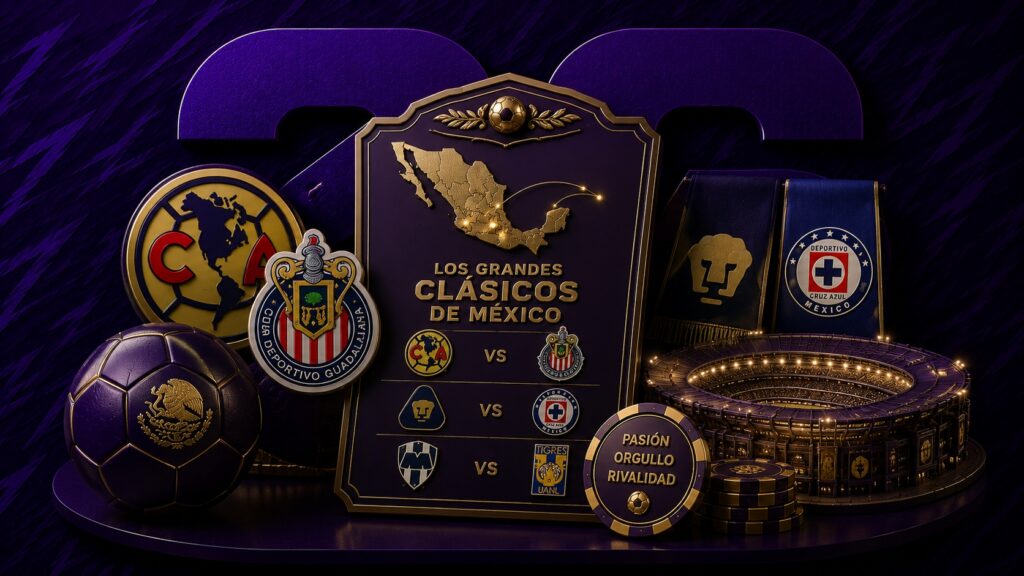
It’s El Súper Clásico. Club América vs Chivas. That’s the answer, and honestly, it’s not particularly close once you zoom out.
This is Mexico’s biggest derby because it was never really just about football. It’s about what each club represents in the national imagination. América, born in Mexico City in 1916, eventually became the team of Televisa, the team of money, the team of the establishment. Chivas, founded in Guadalajara in 1906, built its identity around something nobody else in Liga MX dares to claim: a roster made exclusively of Mexican players. Pure cantera. Pure national pride.
So when these two meet, you’re watching Mexico City against Guadalajara. Big capital versus tradition. The “system” versus the “people’s team.” Fair or not, that’s the narrative every fan has absorbed since childhood.
The numbers back it up. Between them, América and Chivas hold the most league titles in Mexican football history. América at the top, Chivas right behind. No other pair of rivals in Mexico can claim that kind of combined silverware. Two clubs that decorated, on the same pitch – it matters more than people admit.
And the audiences? Súper Clásico matches consistently pull the highest television ratings of any Liga MX fixture, year after year. Not by a small margin either. People in Tijuana, in Mérida, in Veracruz tune in even when they support neither side. That national reach is the giveaway.
Why El Súper Clásico Matters Beyond Football
Here’s where it gets interesting. The rivalry stopped being purely sporting a long time ago.
América became the villain of Mexican football mostly because Televisa made them impossible to ignore. Decades of broadcast dominance turned the Águilas into the team you either loved fiercely or despised with everything you had. Almost no middle ground. Ask anyone over forty about “Odiame Más” and watch their face.
Chivas leaned hard into the opposite identity. Only Mexican players. Working-class roots in Guadalajara. The Rebaño Sagrado, the “sacred flock.” Their fans don’t just support a team – they defend a worldview about what Mexican football should look like.
That clash of myths is why Súper Clásico games carry weight that regular fixtures simply can’t match. It’s class symbolism, regional identity, and media power crashing into each other twice a year. The football is almost a side dish.
The Main Challenger: Clásico Regio
Now, if you’re going to push back on El Súper Clásico, there’s one serious case to make: the Clásico Regio. Monterrey vs Tigres.
And it’s a good argument. Probably the best one available.
Over the last fifteen years or so, no derby in Mexico has produced better football than this one. Both clubs spend big. Both clubs win. Both play in modern, packed stadiums in the same metropolitan area, which means the city literally splits down the middle every time they meet. The BBVA and the Universitario sit a short drive apart, and the rivalry spills into workplaces, schools, and family WhatsApp groups in ways outsiders tend to underestimate.
The atmosphere is genuinely elite. Tigres fans bring sound and color that rivals anything in CONMEBOL. Rayados counter with their own intensity. Week after week, these two clubs have been pushing each other toward a genuinely high standard, in front of crowds that are among the loudest in the country. Liguilla finals between them have produced some of the most memorable moments in recent Liga MX history.
So why doesn’t it take the crown? Mostly reach. The Clásico Regio is enormous in Nuevo León and across the north. But it doesn’t grip the entire country the same way Súper Clásico does. A fan in Puebla might watch out of curiosity. A fan in Puebla watches América vs Chivas because their abuelo made them.
Still, if someone tells you Clásico Regio is the best derby in Mexico right now, they’re not wrong. Biggest and best are different conversations though – and we’ll get there.
Other Major Mexican Derbies
A few more deserve real mention.
Clásico Joven – América vs Cruz Azul
The “young classic,” born in the 70s when both clubs dominated Mexican football simultaneously. It’s a Mexico City derby with serious teeth. Cruz Azul’s long, painful trophy drought – finally broken in 2021 – gave this rivalry a particular flavor of suffering that América fans loved to weaponize. When these two meet in a final, the capital basically stops functioning.
Clásico Capitalino – América vs Pumas
Another Mexico City clash, and culturally fascinating. Pumas, the UNAM university team, is student culture, independence, a more bohemian football identity. América is, well, everything Pumas fans claim to dislike. Smaller in national impact than Súper Clásico, but inside the capital, it hits differently.
Regional rivalries worth a nod
Atlas vs Chivas (the Clásico Tapatío) is older than people remember and carries real history in Guadalajara. Pachuca vs León has had some fierce moments. And the old León vs Chivas matches from the golden era still get whispered about by older fans who watched them live.
Biggest Derby vs Best Derby: Not Always the Same Thing
This is the nuance most articles skip, and it actually matters.
“Biggest” measures cultural footprint. National reach. Historical weight. Accumulated mythology around two badges. By that standard, El Súper Clásico wins, and it’s hard to argue otherwise.
“Best” is a different animal entirely. Best can mean current football quality, intensity, atmosphere, modern relevance. By that measure, Clásico Regio probably edges ahead right now. That sustained quality from both clubs, that crowd noise, that consistent level of football – it’s real, and people who’ve been to both derbies tend to say so quietly.
Both things can be true at once. América vs Chivas is the biggest. Monterrey vs Tigres might be the better derby to actually watch in 2024. Mature football conversation allows for both without one cancelling the other out.
Most Memorable Derby Moments
Some matches just refuse to fade.
The 1983-84 Liga final between América and Chivas remains a reference point for older generations – a series that defined an era and cemented the rivalry’s place at the top of Mexican football. The Súper Clásico has produced countless other chapters since, but that one carries a particular gravity.
More recently, the 2017 Apertura final between Monterrey and Tigres delivered exactly what the Clásico Regio always promises – two heavyweights settling the league title between themselves, with the city tearing itself apart for two legs. Tigres took it, and the celebrations basically broke San Nicolás.
Cruz Azul’s 2021 title run, ending decades of trauma, added another layer to the Clásico Joven. América fans had spent years mocking that drought. When it finally ended, the relief inside La Máquina’s fanbase was almost spiritual.
Why Derby Matches Matter for Football Fans (and Bettors)
One quick thought before wrapping up. Derby football breaks the usual rules.
Form doesn’t matter the same way. A team can be eighth in the table, struggling for weeks, and turn up against their biggest rival looking like an entirely different side. Emotion drives these games more than tactics. Players who barely sweated all season suddenly run themselves into the ground.
For fans, that’s the addiction. For anyone tracking the football side more analytically, it’s a reminder that historical pattern recognition matters more than recent form in fixtures like Súper Clásico or Clásico Regio. You can’t just read the table and call it.
The unpredictability is the point. It’s also part of why these rivalries keep their grip on Mexican football culture, even as the sport itself keeps shifting around them.
So, Mexico’s Biggest Derby?
El Súper Clásico. Club América vs Chivas. The history, the trophies, the cultural symbolism, the television numbers, the way the whole country leans in when these two play – everything points the same direction.
Clásico Regio has the better football right now. Clásico Joven has the deepest Mexico City drama. Other rivalries have their own loyal corners of the country. All of that is real. None of it should get dismissed.
But when the conversation is about which derby actually defines Mexican football – which one your grandfather argued about and your kids will argue about – it’s América vs Chivas. That’s been true since long before most current fans were born. And whatever Liga MX goes through next, that fixture isn’t giving up its spot quietly.