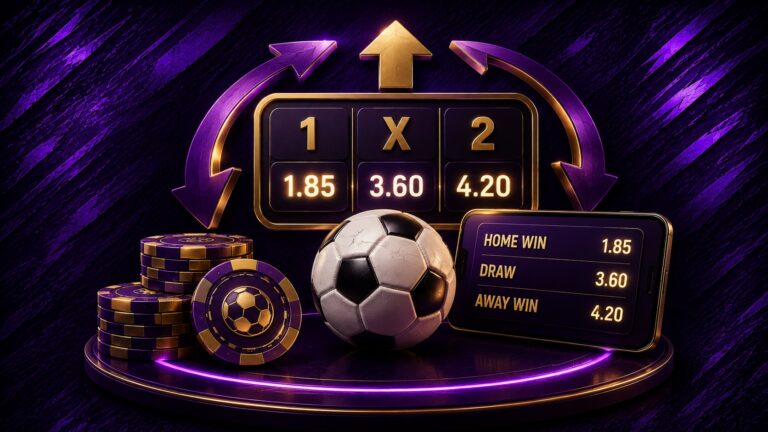


You’ve opened a betting slip, glanced at the football section, and seen something like “+150” next to one team and “1.67” next to another. Confusing, right? Don’t worry, those numbers all say the same thing in different languages, and once you crack the code, everything clicks.
What Football Odds Actually Tell You
Odds are basically the bookmaker’s best guess at how likely something is to happen, wrapped together with a small cut for the house. That’s it. Whether you’re staring at momios americanos on Hard Rock Bet MX or fractional odds on a UK site, the numbers are doing two jobs at once: telling you the probability and telling you what you’d win.
Odds as probability, not just payout
Here’s the part most beginners miss. Every set of odds hides an implied probability inside it. The quick formula for American odds works like this:
- For negative odds: probability = (-odds) / (-odds + 100)
- For positive odds: probability = 100 / (odds + 100)
So if Tigres is listed at -200, the implied probability is 200 / 300 = roughly 66.7%. The book is saying Tigres wins about two-thirds of the time. Bookmakers also bake in a margin (sometimes called the “vig” or “juice”), which is why if you add up the implied probabilities of both teams plus the draw, you’ll get something over 100%. That extra slice is how the house pays the bills.
Why odds change before kickoff
Odds move. Sometimes a lot. A team posts their lineup and the star striker isn’t there, the line shifts. Heavy money piling on one side? It shifts. Rain in Monterrey, an injury rumor on social media, even sharp bettors hammering one outcome – any of it can nudge a line. The number you saw Tuesday morning isn’t necessarily what you’ll get Saturday night.
American Odds (Moneyline): Reading the +/- Signs
If you’ve used a US sportsbook, you’ve seen these. The moneyline is just “who wins?” expressed with a plus or minus sign. The favorite gets a minus. The underdog gets a plus. Simple as that.
Negative odds (the favorite)
Negative odds tell you how much you need to risk to win 100 units. If Club América is listed at -180, you’d risk $180 pesos to win $100 pesos in profit. Bet $360, win $200 in profit (plus your stake back, so $560 total returned). The bigger the minus number, the heavier the favorite, and the less your potential profit relative to your stake.
Positive odds (the underdog)
Positive odds flip the script. They show how much profit you’d win on a 100-unit bet. Pumas at +160 means a $100 peso bet returns $160 in profit. Bet $250, win $400 in profit if Pumas pulls the upset.
Quick worked example. Say it’s Club América -180 vs. Pumas +160 in a Liga MX clásico capitalino. You put $500 pesos on América:
- Profit if América wins: $500 × (100/180) = about $277.78
- Total payout: $777.78 (your stake plus the profit)
Now the same $500 on Pumas at +160:
- Profit if Pumas wins: $500 × (160/100) = $800
- Total payout: $1,300
Bigger risk, bigger reward. That’s the whole story behind American vs decimal odds when you’re looking at the moneyline side.
Decimal and Fractional Odds Explained
Most Mexican bettors I’ve talked to actually prefer decimals. They’re cleaner. There’s no mental gymnastics with plus signs or fractions, just one number that does all the work.
Decimal odds (called momios decimales in Spanish) include your stake in the result. The math: stake × odds = total payout. If Manchester City is at 1.50 and you bet $100, you get back $150 total. Your profit is $50. Easy.
Fractional odds are the British classic. You’ll see them as 1/2, 5/1, 11/4, that kind of thing. The fraction shows profit-to-stake. So 1/2 means for every $2 you bet, you profit $1. A 5/1 shot means $5 profit for every $1 staked. They feel old-school but they’re still everywhere in UK markets and horse racing.
Here’s the same Premier League line in all three formats. Picture Manchester City hosting Brentford, City the heavy favorite:
| Format | Man City (favorite) | Brentford (underdog) |
|---|---|---|
| American | -200 | +450 |
| Decimal | 1.50 | 5.50 |
| Fractional | 1/2 | 9/2 |
Same probability. Same payout. Just dressed differently. Once you see it laid out side by side, the mystery kind of evaporates.
Converting Between Formats and Calculating Implied Probability
You don’t need to memorize every conversion. But knowing the basics helps you check yourself, especially when you’re shopping lines or comparing what one site offers versus another.
Quick conversion formulas
- Decimal to implied probability: 1 / decimal odds. So 2.50 = 1/2.50 = 40%.
- Fractional to decimal: (numerator / denominator) + 1. So 5/2 becomes 2.5 + 1 = 3.50.
- American (+) to decimal: (odds / 100) + 1. So +260 = 3.60.
- American (-) to decimal: (100 / odds) + 1. So -150 = 1.667.
Spotting value with implied probability
This is where things get interesting. Imagine Real Madrid vs. PSG in the Champions League knockouts, and the draw is offered at +260. Plug it in: 100 / (260 + 100) = 27.8%. The book thinks there’s roughly a 28% chance of a draw.
Now ask yourself: based on how both teams have been playing, how tight their last few matches were, do you think the draw is more likely than 28%? If you genuinely believe it’s, say, 35%, that’s a value bet by the textbook definition. If you think it’s actually less likely, you skip it.
This is the core of football betting for beginners who want to grow past just picking favorites. You’re not betting on who wins. You’re betting on whether the odds underestimate something.
One honest caveat. Estimating probabilities better than a bookmaker is hard. Really hard. They have models, data teams, and millions of dollars of action helping them sharpen lines. So treat value-hunting as a long game, not a magic trick.
Switching Odds Formats on Hard Rock Bet MX
Good news. You don’t have to pick one format and live with it. Hard Rock Bet MX lets you toggle between American, decimal, and fractional whenever you want.
On the app or desktop site:
- Open the menu (usually the icon in the top corner)
- Go to Settings or Preferences
- Find “Odds Format” or “Formato de Momios”
- Pick American, Decimal, or Fractional
- Save, and every market on the site updates instantly
If you’re learning cómo leer momios for the first time, decimal is probably the friendliest place to start. You see one number, you multiply by your stake, you know your payout. No signs to interpret, no fractions to simplify.
Also worth knowing: the bet slip itself does the math for you. Type in your stake, and it instantly shows total return and potential profit. Think of it as a safety net while your brain is still wiring up the formulas. Even seasoned bettors lean on it, especially for parlays where the multiplication gets messy fast.
One small tip. Switch formats once or twice just to see the same match expressed three different ways. It’s the fastest way to make the connection click in your head. After a week or two you’ll barely notice which format you’re using.
A quick word before you bet
Betting should be fun. Entertainment money, not rent money. Set a budget you’re okay losing, stick to it, and walk away when you’ve hit your limit (winning or losing). You have to be 18 or older to bet in Mexico, and if it ever stops feeling like fun, take a break. Hard Rock Bet MX has deposit limits and self-exclusion tools built right in. Use them if you need them. No shame in it.
Wrapping up
American, decimal, fractional. Three costumes, same actor. -200, 1.50, and 1/2 all describe the exact same wager with the exact same implied probability. Once that sinks in, reading a betting board stops feeling like decoding hieroglyphics.
Best thing you can do now? Open Hard Rock Bet MX, flip between formats on a Liga MX or Premier League match, and watch the numbers shift while the underlying bet stays identical. Do that a few times and you’ll never feel lost on a betting slip again.